

1. Introduction – Why Students Are Exploring Creative Careers in 2026
In 2026, career choices after 12th are changing rapidly. Students are no longer limiting themselves to only traditional career options like engineering, banking, or desk-based corporate jobs. Today’s generation wants careers that are dynamic, creative, exciting, and full of real-world experiences. Many students now prefer industries where they can travel, meet new people, work on exciting projects, and build a strong personal brand while earning a successful income.
The rise of social media, influencer culture, digital branding, live entertainment, destination weddings, sports leagues, fashion events, and corporate experiences has completely transformed the professional landscape in India. Companies now focus heavily on customer experiences, brand activations, product launches, exhibitions, and experiential marketing. As a result, the event industry has become one of the fastest-growing sectors in the country.
Students after 12th are increasingly moving beyond traditional BBA, BCom, or BTech programs because they want industry-focused education that offers practical exposure and faster career opportunities. This is where a BBA in Event Management has emerged as a powerful career option.
A BBA in Event Management combines business management with creativity, communication, marketing, branding, and production management. It prepares students for exciting careers in weddings, entertainment, sports events, corporate events, influencer marketing, luxury experiences, celebrity management, and much more.
India’s event industry is expected to grow significantly between 2026 and 2035 due to increasing demand for live experiences, destination celebrations, startup networking events, concerts, digital creator events, and international collaborations.
“Not every student wants a desk job in 2026 — many want creativity, travel, networking, and exciting careers.”
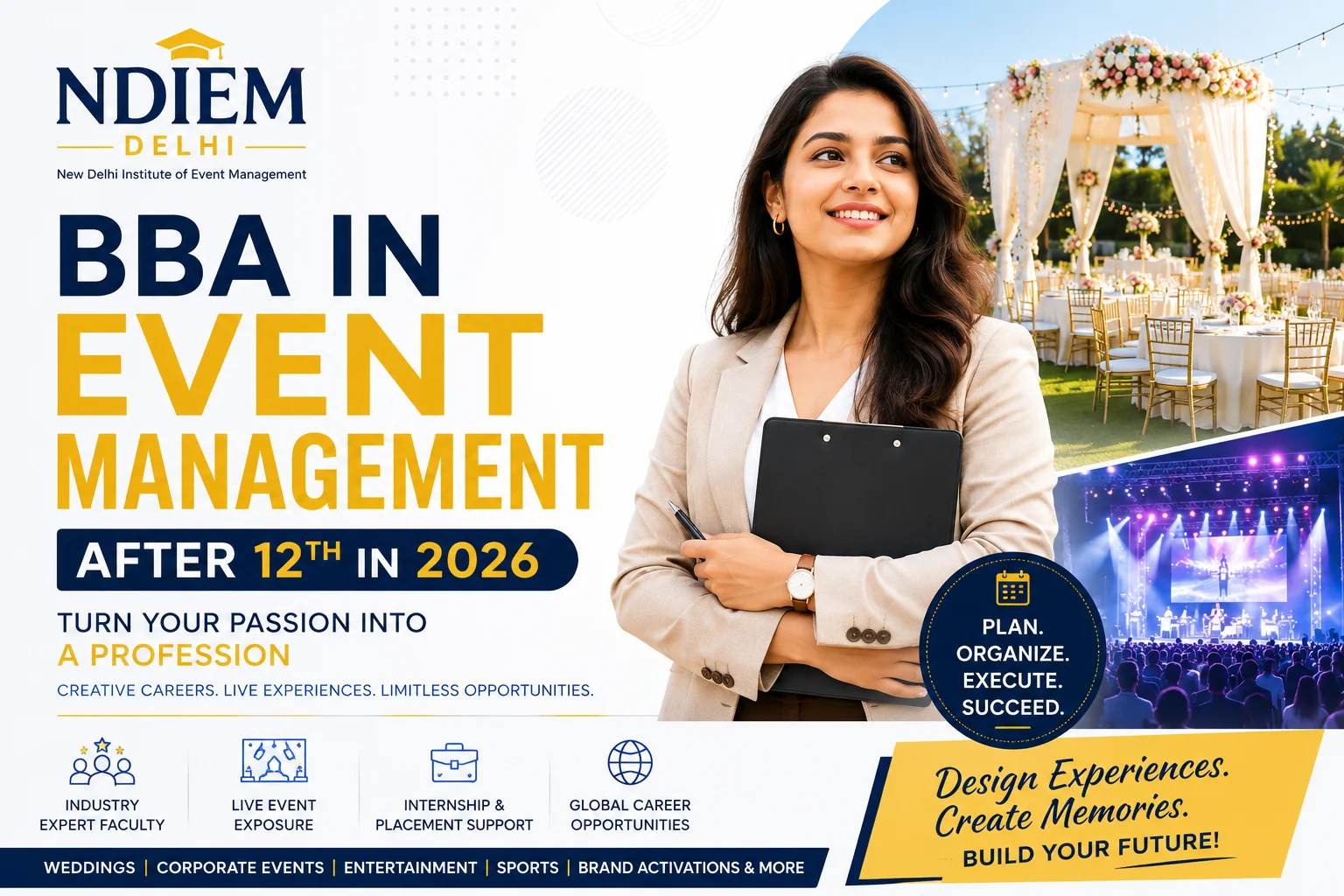
For students who dream of building a career in this fast-paced industry, pursuing a BBA in Event Management in Delhi from a reputed institute like NDIEM Delhi can be an excellent choice. With practical exposure, live event learning, internships, and industry networking, students can gain real-world experience while studying.
A professional event management education not only develops technical knowledge but also builds confidence, leadership, personality, communication skills, and entrepreneurial thinking. In today’s competitive world, these qualities are highly valuable across industries.
2. What is a BBA in Event Management?
A BBA in Event Management is a specialized undergraduate degree program that combines business administration with event planning, event production, branding, marketing, hospitality, and client management. It is designed for students who want to build careers in the rapidly growing event and entertainment industry after completing their 12th education.
Unlike traditional business degrees that mainly focus on classroom-based theory, a BBA Event Management course offers a balance of academic learning and practical industry exposure. Students learn how to manage different types of events, coordinate with clients, handle budgets, create marketing campaigns, manage teams, and execute successful experiences.
The event industry today is much larger than just weddings or parties. It includes:
- Corporate conferences
- Music concerts
- Fashion shows
- Sports leagues
- Government events
- Luxury destination weddings
- Brand launches
- Influencer events
- Digital and hybrid events
- International exhibitions
- Cultural festivals
A modern Event Management course after 12th prepares students to work in all these areas professionally.
Combination of Business + Creativity
One of the biggest advantages of a BBA in Event Management is that it combines business knowledge with creativity. Students not only learn event execution but also understand the business side of the industry.
The course usually includes subjects related to:
- Marketing
- Advertising
- Brand management
- Public relations
- Event production
- Hospitality management
- Sponsorship management
- Budget planning
- Consumer behavior
- Communication skills
- Digital marketing
- Business operations
This combination makes students industry-ready from an early stage.
Difference Between Traditional BBA and BBA in Event Management
| Traditional BBA | BBA in Event Management |
|---|---|
| Mostly business theory | Business + practical event training |
| Limited live exposure | Frequent event participation |
| Generic management learning | Specialized event industry skills |
| Corporate office-focused | Entertainment & experiential industry-focused |
| Less practical creativity | High creative involvement |
A regular BBA may prepare students for general corporate roles, but a BBA Event Management course after 12th trains students specifically for the fast-growing event and entertainment sector.
Practical Learning Environment
One of the strongest aspects of event management education is practical exposure. Students are often involved in:
- College festivals
- Fashion shows
- Celebrity events
- Corporate seminars
- Brand activations
- Wedding setups
- Sponsorship coordination
- Stage management
- Production planning
This hands-on experience helps students understand real industry challenges and solutions.
Live Event Exposure
In the event industry, practical knowledge matters more than theoretical learning alone. That is why institutes like NDIEM Delhi focus heavily on live event training and industry exposure.
Students get opportunities to:
✔ Coordinate teams
✔ Handle backstage operations
✔ Work with vendors
✔ Interact with celebrities and clients
✔ Manage audiences
✔ Understand production logistics
✔ Execute marketing campaigns
This real-world learning builds confidence and prepares students for professional careers.
Industry-Focused Curriculum
The event industry is evolving rapidly in 2026. Today’s events involve:
- AI-powered planning tools
- Digital promotions
- Social media campaigns
- Hybrid experiences
- Influencer collaborations
- Virtual audience engagement
- Experiential branding
Therefore, the curriculum of a modern BBA in Event Management in Delhi focuses on current industry trends and technologies.
Students are trained to become creative managers who can handle both traditional and modern event ecosystems.
Personality Development and Communication
Another major benefit of this course is personality development. Event managers constantly interact with clients, brands, media teams, artists, and audiences. Therefore, students naturally improve:
- Public speaking
- Presentation skills
- Leadership
- Team coordination
- Problem-solving
- Negotiation abilities
- Confidence levels
These skills are valuable not only in events but across many industries.
Entrepreneurial Opportunities
Many students who pursue a Career in Event Management after 12th eventually start their own businesses. Some launch:
- Wedding planning companies
- Event production firms
- Artist management agencies
- Corporate event agencies
- Social media event brands
- Luxury celebration companies
Since India’s event industry is growing rapidly, entrepreneurial opportunities are huge.
A specialized degree like a Best BBA in Event Management course can help students build the foundation required to succeed in this competitive industry.
3. Why Event Management is One of the Fastest-Growing Industries in India
The event industry in India has experienced massive growth over the last decade, and in 2026, it is becoming one of the most exciting career sectors for students. From luxury weddings to international concerts, corporate conferences to influencer events, the demand for professional event managers is increasing rapidly.
India’s growing economy, digital transformation, social media expansion, startup ecosystem, and rising lifestyle aspirations have all contributed to the growth of the event management industry.
Today, events are no longer simple gatherings. They have become powerful business, branding, entertainment, and marketing experiences.
Growth of the Indian Wedding Industry
India hosts millions of weddings every year, making it one of the largest wedding markets globally. The Indian wedding industry is valued at billions of dollars and continues to expand rapidly.
Modern weddings now include:
- Destination weddings
- Luxury décor
- Celebrity performances
- Themed functions
- International venues
- Wedding content creation
- Social media coverage
- Personalized guest experiences
Families today invest heavily in professional wedding planning services. This has created huge demand for skilled wedding planners and event coordinators.
Students pursuing a BBA in Event Management can build excellent careers in this segment.
Rise of Corporate Events
Businesses now organize various events for branding, networking, employee engagement, and marketing purposes.
Corporate events include:
- Product launches
- Conferences
- Award ceremonies
- Trade exhibitions
- Investor meets
- Leadership summits
- Brand activations
- Startup expos
As companies compete for audience attention, professionally managed events have become essential for business growth.
This creates strong career opportunities for graduates from a BBA Event Management course after 12th.
Concerts and Music Festivals
India’s entertainment industry is growing rapidly with increasing demand for:
- Live concerts
- EDM festivals
- Music tours
- College festivals
- Cultural shows
- Celebrity events
International artists and Indian performers now organize large-scale productions across major cities.
Managing these events requires skilled professionals trained in:
- Production
- Audience management
- Branding
- Sponsorship
- Artist coordination
- Logistics
This is why students choosing an Event Management degree course today have strong future prospects.
Sports and League Events
India’s sports ecosystem has transformed significantly due to leagues and entertainment-based sporting events.
Examples include:
- Cricket leagues
- Kabaddi leagues
- Football tournaments
- Marathon events
- Esports competitions
- School and college championships
Sports events involve complex operations and require professional management teams.
Students interested in sports and entertainment can build careers as sports event managers and activation specialists.
Influencer and Creator Economy Events
One of the biggest trends in 2026 is the creator economy. Influencers, YouTubers, podcasters, and digital creators frequently organize:
- Fan meetups
- Brand collaborations
- Creator summits
- Social media launches
- Live experiences
Brands now spend heavily on experiential marketing and creator engagement events.
This trend is opening completely new career opportunities for students pursuing a Career in Event Management after 12th.
Luxury Destination Weddings
Destination weddings are booming both in India and internationally. Locations like Goa, Rajasthan, Thailand, Bali, Dubai, and Europe are becoming popular wedding destinations for Indian families.
Luxury weddings require professionals who can handle:
- International logistics
- Guest hospitality
- Vendor management
- Entertainment planning
- Luxury décor
- Production management
This segment offers high-paying opportunities in the event industry.
Government and Cultural Events
Government bodies and tourism departments also organize:
- Cultural festivals
- National celebrations
- Tourism events
- International summits
- Public awareness campaigns
These events require large-scale event planning expertise and provide stable career opportunities.
Hybrid and Digital Events
The event industry has also evolved technologically. In 2026, hybrid events are highly popular.
Hybrid events combine:
- Physical audiences
- Virtual streaming
- AI-powered engagement
- Interactive digital experiences
Companies now require professionals who understand both offline and online event execution.
AI-Driven Event Planning
Artificial intelligence is transforming event operations through:
- Smart registration systems
- Audience analytics
- AI scheduling
- Chatbots
- Personalized attendee experiences
However, while AI can automate processes, creativity and human coordination remain irreplaceable.
“AI can automate systems, but memorable live experiences still need human creativity.”
Experiential Marketing Trends in 2026
Brands today focus more on experiences rather than traditional advertising.
Experiential marketing includes:
- Interactive brand zones
- Live activations
- Immersive experiences
- Influencer-driven campaigns
- Customer engagement events
This trend is expected to grow massively between 2026 and 2035.
Future Scope and Industry Statistics
Industry experts predict continued growth in:
- Wedding planning
- Corporate events
- Luxury experiences
- Sports entertainment
- International event management
- Digital creator events
The industry is creating thousands of jobs annually for creative professionals.
This makes pursuing a BBA in Event Management in Delhi from reputed institutes like NDIEM Delhi a smart and future-ready career choice.
4. Why Choose a BBA in Event Management After 12th?
Choosing the right career after 12th is one of the biggest decisions in a student’s life. In 2026, students are no longer looking only for degrees that provide theoretical education. They want careers that offer creativity, practical learning, exciting work environments, networking opportunities, and strong future growth. This is one of the biggest reasons why many students are now choosing a BBA in Event Management after 12th.
The event industry offers a unique combination of business, creativity, travel, communication, entertainment, marketing, and entrepreneurship. Unlike traditional degree programs that mostly focus on classroom learning, event management education provides real-world exposure from the beginning.
A BBA Event Management course after 12th helps students build industry-focused skills while preparing them for dynamic careers in weddings, corporate events, entertainment, influencer marketing, sports management, luxury experiences, and international event planning.
Early Career Specialization
One major advantage of pursuing a BBA in Event Management after 12th is early specialization. Instead of spending years studying generalized subjects, students directly enter a professional field that is growing rapidly.
By specializing early, students gain:
- Better industry understanding
- Faster practical exposure
- Strong networking opportunities
- Specialized knowledge
- Competitive career advantage
Students start understanding how real events are planned, managed, marketed, and executed from the first year itself.
This gives them a head start compared to students pursuing general degree programs.
Practical Industry Skills
The event industry values practical experience more than theoretical knowledge alone. That is why a professional Event Management course after 12th focuses heavily on real-world training.
Students learn how to:
- Coordinate teams
- Manage vendors
- Handle clients
- Organize logistics
- Execute live productions
- Plan event budgets
- Promote events digitally
- Solve problems under pressure
These practical skills are extremely valuable because the event industry operates in real-time environments where quick decisions matter.
Faster Industry Exposure
Unlike many traditional courses where students experience the industry only after graduation, event management students often participate in live events during their studies.
This exposure helps students understand:
- Real client expectations
- Event pressure handling
- Team coordination
- Professional communication
- Time-sensitive operations
- Production management
By the time students graduate, many already have internship and event experience in their portfolios.
This practical exposure increases employability significantly.
Creative Freedom
One of the biggest reasons students choose a Career in Event Management after 12th is creativity.
Event management allows students to work on:
- Theme concepts
- Stage designs
- Entertainment ideas
- Brand experiences
- Luxury décor
- Celebrity coordination
- Marketing campaigns
- Experiential activations
Students who enjoy creativity, planning, communication, and innovation often find this industry highly rewarding.
Unlike repetitive office jobs, the event industry constantly introduces new projects and challenges.
Every event is different.
Every client requirement is different.
Every experience is unique.
This makes the career exciting and dynamic.
Learn Real Business Skills
A Best BBA in Event Management course is not only about event execution. It also teaches strong business fundamentals.
Students develop knowledge in:
- Marketing
- Branding
- Finance
- Budgeting
- Sponsorship management
- Client servicing
- Public relations
- Team management
- Business communication
These business skills help students succeed not only in events but also in entrepreneurship and corporate careers.
Many event management graduates later start their own companies because they already understand operations, branding, and customer management.
Build Confidence & Communication
The event industry naturally improves personality development because students constantly interact with people.
They communicate with:
- Clients
- Vendors
- Celebrities
- Sponsors
- Media professionals
- Guests
- Corporate executives
As a result, students become more confident and professionally polished.
Skills developed include:
- Public speaking
- Negotiation
- Presentation
- Leadership
- Networking
- Team coordination
These qualities are highly valuable in every industry.
Work on Live Events
One of the biggest advantages of studying at institutes like NDIEM Delhi is live event exposure.
Students often participate in:
- College festivals
- Fashion shows
- Brand activations
- Corporate events
- Cultural programs
- Award ceremonies
- Entertainment productions
- Celebrity events
This hands-on learning creates practical understanding that textbooks alone cannot provide.
Students learn how real event environments function.
They understand deadlines, audience management, backstage operations, production coordination, and client expectations.
Travel Opportunities
The event industry is ideal for students who enjoy travel and dynamic work environments.
Event professionals often travel for:
- Destination weddings
- Corporate conferences
- Sports tournaments
- Luxury events
- International exhibitions
- Tourism festivals
Unlike fixed office careers, event management offers exciting work experiences across different cities and countries.
For many students, this is one of the most attractive aspects of the profession.
Career Flexibility
A BBA in Event Management in Delhi opens opportunities across multiple industries.
Graduates can work in:
- Wedding planning companies
- Corporate agencies
- Entertainment firms
- Hospitality companies
- PR agencies
- Media houses
- Sports management companies
- Luxury brands
- Digital creator agencies
This flexibility allows students to explore different career paths based on their interests.
Entrepreneurial Opportunities
The event industry offers strong business opportunities for young entrepreneurs.
Many students eventually launch:
- Wedding planning agencies
- Event production companies
- Artist management firms
- Event décor businesses
- Brand activation agencies
- Influencer event companies
India’s event sector continues to expand rapidly, making entrepreneurship highly promising.
Strong Demand for Skilled Professionals
As events become larger and more professional, companies now prefer trained event managers rather than inexperienced organizers.
This has increased demand for graduates from reputed institutes offering:
- Best BBA in Event Management course
- Event Management degree course
- BBA Event Management admission 2026
Professional education helps students gain credibility and industry trust.
Better Personality Development
Event management education transforms students personally and professionally.
Students become:
- More confident
- Better communicators
- Strong leaders
- Faster decision-makers
- More organized
- Better team players
These qualities help students throughout their careers.
Industry Networking Advantage
Networking is one of the most powerful benefits of event management education.
Students get opportunities to connect with:
- Event companies
- Corporate brands
- Celebrities
- Sponsors
- Industry experts
- Production teams
- Influencers
Strong industry networking can lead to internships, placements, collaborations, and future business opportunities.
Why Delhi is a Great Location for Event Management Education
Delhi is one of India’s biggest event and business hubs.
The city hosts:
- Corporate summits
- Government events
- Fashion weeks
- Luxury weddings
- Brand launches
- International conferences
- Entertainment productions
Students pursuing a BBA in Event Management in Delhi benefit from continuous exposure to major industry activities.
Institutes like NDIEM Delhi provide students with access to this vibrant ecosystem.
5. Skills You Learn During a BBA in Event Management
A professional BBA in Event Management does much more than teach event planning. It develops a wide range of practical, managerial, communication, and leadership skills that are valuable across industries.
In 2026, employers are looking for professionals who can think creatively, solve problems quickly, manage teams effectively, and handle real-world challenges confidently. Event management education helps students develop all these qualities through practical learning and live industry exposure.
A modern Event Management course after 12th prepares students not only for the event industry but also for business, marketing, branding, hospitality, public relations, media, and entrepreneurship.
Leadership Skills
Every event requires strong leadership because multiple teams work together simultaneously.
Students learn how to:
- Lead event teams
- Coordinate departments
- Manage deadlines
- Delegate responsibilities
- Supervise operations
Leadership skills developed during live events help students become confident professionals capable of handling pressure situations.
Communication Skills
Communication is one of the most important skills in the event industry.
Students regularly interact with:
- Clients
- Sponsors
- Vendors
- Celebrities
- Audiences
- Media teams
As a result, they improve:
- Verbal communication
- Presentation skills
- Professional speaking
- Negotiation abilities
- Public interaction confidence
These skills are useful not only in event management but also in corporate and entrepreneurial careers.
Sponsorship Handling
Many events depend heavily on sponsorship partnerships.
Students learn how to:
- Approach sponsors
- Create proposals
- Build brand collaborations
- Negotiate sponsorship deals
- Manage sponsor expectations
This knowledge is highly valuable in marketing and business development roles.
Budgeting and Financial Planning
Events involve significant financial planning.
Students are trained in:
- Budget creation
- Expense tracking
- Vendor costing
- Revenue planning
- Profitability analysis
Understanding budgeting helps students manage projects professionally and efficiently.
Marketing and Branding
Modern events are closely connected with branding and digital promotion.
Students learn:
- Event marketing
- Brand positioning
- Social media campaigns
- Audience engagement
- Promotional strategies
- Influencer collaborations
This makes graduates highly relevant in today’s digital economy.
Public Relations and Networking
Public relations play a major role in successful event execution.
Students understand:
- Media communication
- Public image management
- Brand reputation
- Networking strategies
- Guest relationship management
These skills are highly useful in PR, media, and corporate communication careers.
Crisis Management
One of the most valuable lessons in event management is handling unexpected situations.
Students learn how to manage:
- Last-minute delays
- Technical failures
- Vendor issues
- Guest concerns
- Weather challenges
- Schedule disruptions
This improves problem-solving abilities and decision-making under pressure.
Client Management
Clients are at the center of every event.
Students develop skills in:
- Understanding client requirements
- Managing expectations
- Delivering experiences
- Handling feedback
- Building long-term relationships
Strong client servicing skills are valuable across industries.
Time Management
Events operate on strict schedules.
Students learn how to:
- Prioritize tasks
- Manage deadlines
- Coordinate timelines
- Execute efficiently
Time management improves productivity and professional discipline.
Social Media Promotion
In 2026, almost every event requires digital visibility.
Students gain understanding of:
- Instagram promotions
- Influencer collaborations
- Event content creation
- Digital audience engagement
- Viral marketing trends
These modern skills increase career opportunities significantly.
Event Production Knowledge
Students also learn technical aspects of event production such as:
- Stage setup
- Sound coordination
- Lighting management
- Backstage operations
- Venue planning
- Technical execution
This practical exposure makes students industry-ready.
Skills Beyond the Event Industry
One of the biggest advantages of a Best BBA in Event Management course is that its skills are transferable across multiple industries.
Graduates can succeed in:
- Marketing
- Hospitality
- Media
- Branding
- Corporate communication
- Entrepreneurship
- Public relations
- Luxury management
Institutes like NDIEM Delhi focus on developing students professionally as well as personally, helping them build versatile careers.
6. Career Opportunities After BBA in Event Management
One of the strongest reasons students choose a BBA in Event Management after 12th is the wide range of career opportunities available in India and internationally. The event industry is no longer limited to wedding planning or small functions. In 2026, it has evolved into a massive ecosystem that includes entertainment, branding, sports, luxury experiences, influencer marketing, hospitality, media, and corporate communications.
As companies and consumers focus more on experiences rather than traditional advertising, the demand for trained event professionals continues to rise rapidly.
Graduates from a professional Event Management degree course can work in multiple industries and explore both creative and managerial career paths.
Event Manager
An Event Manager is responsible for planning, organizing, and executing events professionally.
Responsibilities include:
- Venue coordination
- Budget management
- Vendor handling
- Client communication
- Team supervision
- Event execution
Event Managers work on corporate events, exhibitions, conferences, award shows, entertainment events, and public festivals.
Experienced professionals in this field can earn highly competitive salaries.
Wedding Planner
Wedding planning is one of the fastest-growing segments in India’s event industry.
Wedding planners manage:
- Décor
- Hospitality
- Entertainment
- Guest experiences
- Vendor coordination
- Destination wedding logistics
Luxury weddings especially offer excellent earning potential.
Students pursuing a Career in Event Management after 12th often choose wedding planning because of its creativity and high demand.
Corporate Event Coordinator
Corporate companies organize events regularly for branding and networking purposes.
Corporate Event Coordinators manage:
- Conferences
- Product launches
- Award ceremonies
- Trade exhibitions
- Employee engagement programs
This sector offers stable career opportunities with corporate exposure.
Exhibition Manager
Exhibitions and trade shows are important marketing platforms for brands.
Exhibition Managers handle:
- Booth planning
- Visitor engagement
- Vendor coordination
- Brand activations
- Production logistics
This field is highly relevant in industries like real estate, technology, fashion, and automobiles.
PR Executive
Public Relations professionals help brands maintain strong public image and media visibility.
Responsibilities include:
- Media coordination
- Brand communication
- Press conferences
- Influencer interactions
- Reputation management
Event management graduates often transition successfully into PR careers.
Celebrity Manager
Celebrity management has become a major profession in the entertainment industry.
Celebrity Managers coordinate:
- Public appearances
- Brand collaborations
- Event scheduling
- Media interactions
- Endorsement campaigns
This role requires strong communication and networking skills.
Brand Activation Manager
Brands now focus heavily on experiential marketing and consumer engagement.
Brand Activation Managers organize:
- Promotional events
- Product experiences
- Mall activations
- Live campaigns
- Influencer collaborations
This field combines creativity with marketing expertise.
Sports Event Manager
Sports leagues and tournaments are growing rapidly in India.
Sports Event Managers coordinate:
- Match operations
- Sponsorships
- Audience experiences
- Team logistics
- Media activities
This segment offers exciting opportunities for sports enthusiasts.
Luxury Wedding Planner
Luxury weddings require premium planning expertise.
Professionals in this segment work on:
- International weddings
- Celebrity weddings
- High-end destination celebrations
- Luxury guest experiences
Luxury planners often earn significantly higher incomes compared to traditional event roles.
Artist Management
Artist management professionals work with:
- Singers
- Influencers
- Performers
- Actors
- Digital creators
Responsibilities include event scheduling, collaborations, promotions, and public image coordination.
Event Production Executive
Production teams handle technical execution of events.
Responsibilities include:
- Stage management
- Sound systems
- Lighting
- Technical coordination
- Backstage management
This role is ideal for students interested in technical creativity.
Entrepreneur / Own Event Company
Many graduates eventually start their own businesses.
Popular startup ideas include:
- Wedding planning agencies
- Décor businesses
- Influencer event companies
- Event production firms
- Artist management agencies
- Luxury experience brands
Entrepreneurship opportunities are massive because the Indian event market continues to expand rapidly.
Salary Scope in India
Salary depends on experience, skills, city, and industry exposure.
Fresh graduates may start with entry-level packages, but growth potential is very strong due to increasing industry demand.
Professionals working in luxury weddings, international events, sports leagues, and entertainment productions often earn significantly higher salaries after gaining experience.
International Career Opportunities
Event management is a global industry.
Graduates can work internationally in areas like:
- Destination weddings
- Hospitality events
- Tourism festivals
- Corporate conferences
- International exhibitions
- Entertainment productions
Countries with strong hospitality and tourism industries offer attractive career opportunities for experienced professionals.
Career Growth Potential
One of the biggest advantages of the event industry is fast career growth.
Talented professionals can quickly move into senior positions because the industry values:
- Creativity
- Leadership
- Networking
- Execution ability
- Client management
Institutes like NDIEM Delhi help students gain practical industry exposure, internships, and networking opportunities that improve career growth significantly.